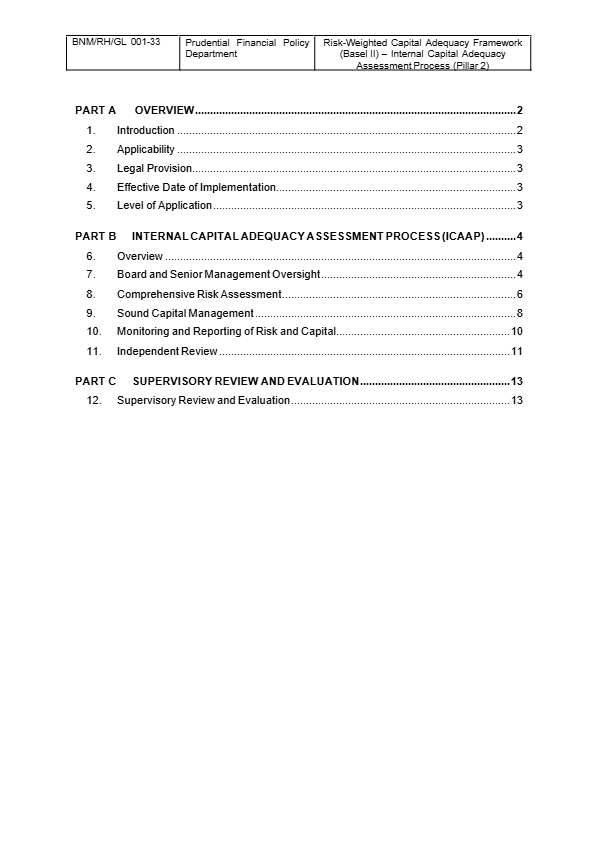
Pillar 2 of the Risk-Weighted Capital Adequacy Framework (RWCAF) aims to ensure that banking institutions have adequate capital to support their operations at all times. It also promotes the adoption of a more forward-looking approach to capital management and encourages banking institutions to develop and employ more rigorous risk management techniques.
Under Pillar 2, the adequacy of a banking institution’s capital will be assessed by both the banking institution and Bank Negara Malaysia (the Bank). This encompasses:
i. an Internal Capital Adequacy Assessment Process (ICAAP) to be carried out by the banking institution in accordance with these Guidelines; and
ii. supervisory review and evaluation of a banking institution’s ICAAP, including an assessment of the quality of the control environment within which the ICAAP is implemented.
While regulatory efforts have been directed at increasing the risk-sensitivity of Pillar 1 capital calculations, there exists limitations to which minimum regulatory capital requirements can be solely relied upon to ensure the overall capital adequacy of an individual banking institution. These include inadequacies in the Pillar 1 framework in capturing all material risks of an individual banking institution, as well as the potential for a deterioration in the banking institution’s operating environment that will adversely affect its overall capital adequacy and compliance with regulatory requirements in the future. Therefore, a banking institution is expected to have in place an ICAAP to ensure that it maintains adequate capital on an ongoing basis to support its business operations beyond minimum regulatory capital requirements under Pillar 1. These Guidelines describe key elements required of an ICAAP, including the determination of internal capital targets that are commensurate with a banking institution’s risk profile and control environment.
This document belongs to Bank Negara Malaysia (BNM). Full access to the original source is available here: https://www.bnm.gov.my/banking-islamic-banking