>
>
Vol. 14
No. 2 >
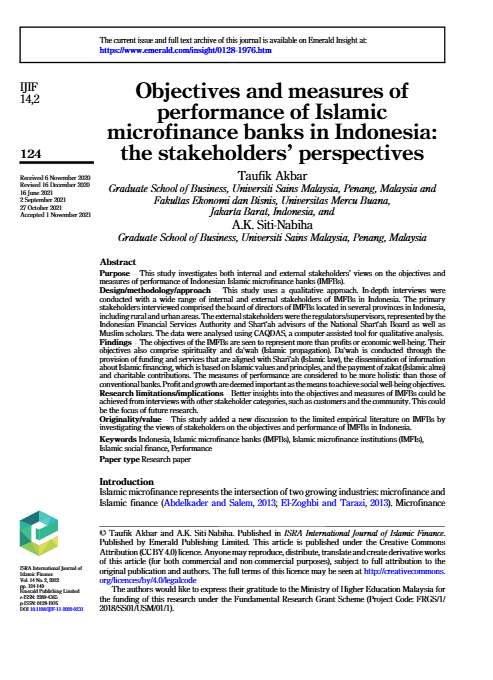
Objectives and measures of performance of Islamic microfinance banks in Indonesia: the stakeholders’ perspectives
Purpose – This study investigates both internal and external stakeholders’ views on the objectives and measures of performance of Indonesian Islamic microfinance banks (IMFBs).
Design/methodology/approach – This study uses a qualitative approach. In-depth interviews were conducted with a wide range of internal and external stakeholders of IMFBs in Indonesia. The primary stakeholders interviewed comprised the board of directors of IMFBs located in several provinces in Indonesia, including rural and urban areas. The external stakeholders were the regulators/supervisors, represented by the Indonesian Financial Services Authority and Sharıʿah advisors of the National Sharıʿah Board as well as Muslim scholars. The data were analysed using CAQDAS, a computer-assisted tool for qualitative analysis.
Findings – The objectives of the IMFBs are seen to represent more than profits or economic well-being. Their objectives also comprise spirituality and daʿwah (Islamic propagation). Daʿwah is conducted through the provision of funding and services that are aligned with Sharıʿah (Islamic law), the dissemination of information about Islamic financing, which is based on Islamic values and principles, and the payment of zakat (Islamic alms)and charitable contributions. The measures of performance are considered to be more holistic than those of conventional banks. Profit and growth are deemed important as the means to achieve social well-being objectives.
Research limitations/implications – Better insights into the objectives and measures of IMFBs could be achieved from interviews with other stakeholder categories, such as customers and the community. This could be the focus of future research.
Originality/value – This study added a new discussion to the limited empirical literature on IMFBs by investigating the views of stakeholders on the objectives and performance of IMFBs in Indonesia.