A letter of guarantee is an indemnity letter issued by the issuing bank (guarantor) upon request by the customer (guaranteed party) to guarantee the beneficiary that the bank’s customer will fulfil his/her contractual obligation. The bank commits itself to pay the beneficiary the sum amount agreed in the event that the customer fails to fulfil his/her contractual obligation to the beneficiary. Though the objective of the guarantee facility could be either to guarantee the financial or non-financial obligation of the bank’s customer, the first is more common than the latter.
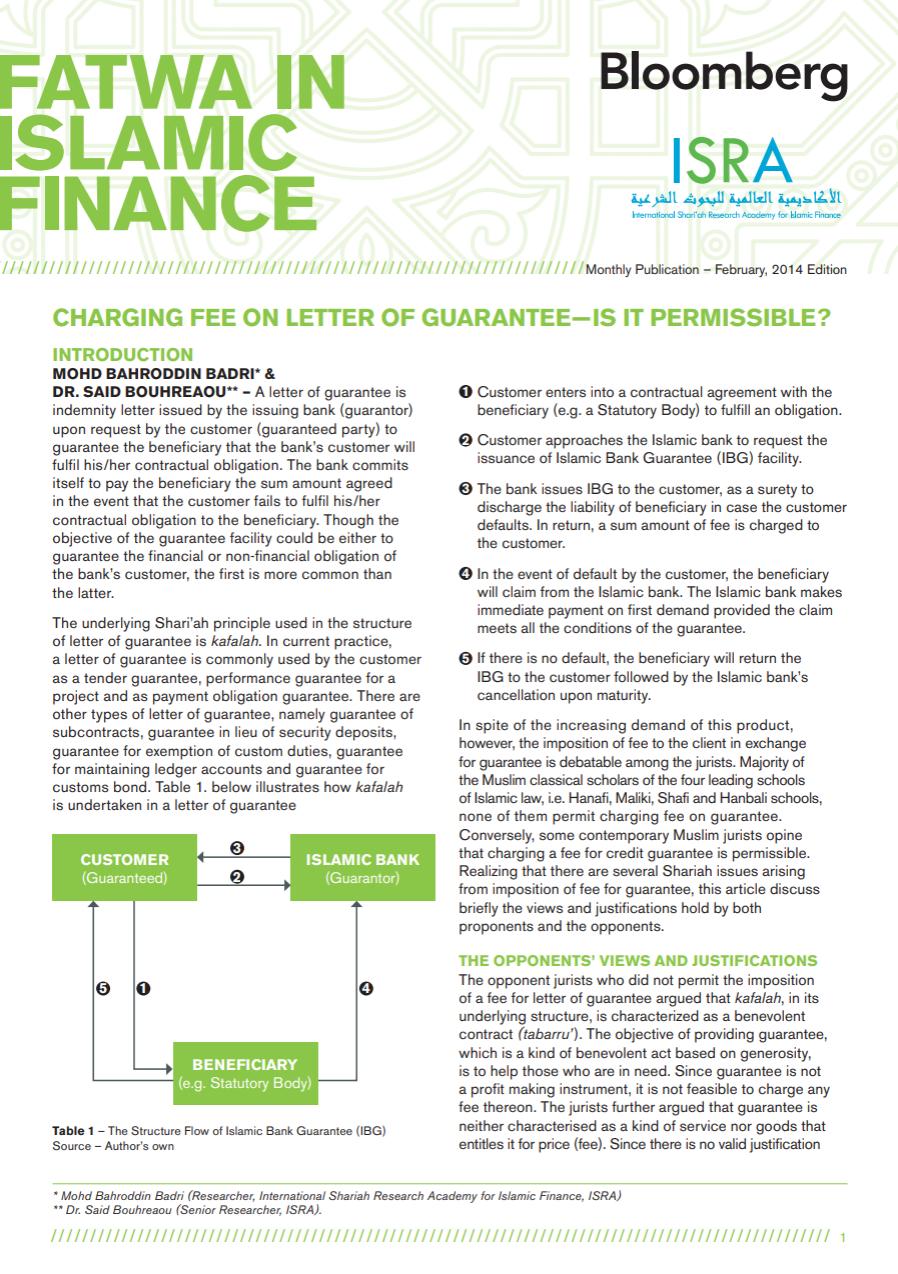
The underlying Shari’ah principle used in the structure of a letter of guarantee is kafalah. In current practice, a letter of guarantee is commonly used by the customer as a tender guarantee, performance guarantee for a project, and as a payment obligation guarantee. There are other types of letter of guarantee, namely guarantee of subcontracts, guarantee in lieu of security deposits, guarantee for exemption of custom duties, guarantee for maintaining ledger accounts, and guarantee for customs bond. Table 1 below illustrates how kafalah is undertaken in a letter of guarantee.