>
>
Vol. 13
No. 1 >
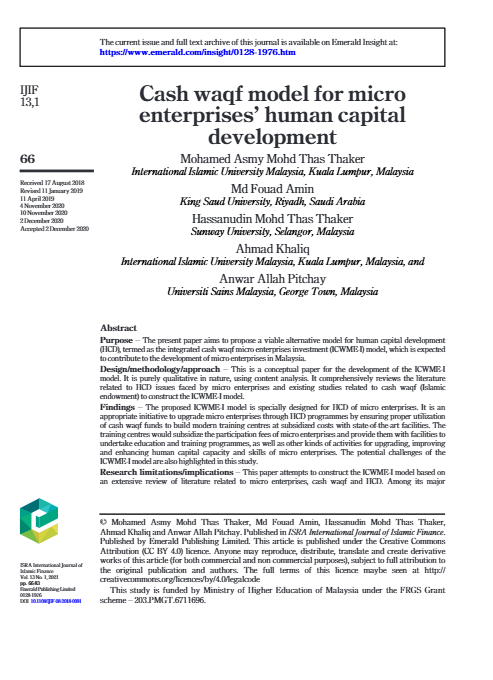
Cash waqf model for micro enterprises’ human capital development
Purpose – The present paper aims to propose a viable alternative model for human capital development(HCD), termed as the integrated cash waqf micro enterprises investment (ICWME-I) model, which is expected to contribute to the development of micro enterprises in Malaysia.
Design/methodology/approach – This is a conceptual paper for the development of the ICWME-I model. It is purely qualitative in nature, using content analysis. It comprehensively reviews the literature related to HCD issues faced by micro enterprises and existing studies related to cash waqf (Islamic endowment) to construct the ICWME-I model.
Findings – The proposed ICWME-I model is specially designed for HCD of micro enterprises. It is an appropriate initiative to upgrade micro enterprises through HCD programmes by ensuring proper utilization of cash waqf funds to build modern training centres at subsidized costs with state-of-the-art facilities. The training centres would subsidize the participation fees of micro enterprises and provide them with facilities to undertake education and training programmes, as well as other kinds of activities for upgrading, improving and enhancing human capital capacity and skills of micro enterprises. The potential challenges of the ICWME-I model are also highlighted in this study.
Research limitations/implications – This paper attempts to construct the ICWME-I model based on an extensive review of literature related to micro enterprises, cash waqf and HCD. Among its major limitations is the fact that the ICWME-I model is not empirically validated and tested in this research. This can be carried out in future studies.
Practical implications – The present study could have an enormous impact on micro entrepreneurs via HCD programmes. The most important impact would be on government budgets, as this ICWME-I model is expected to generate its own funds from cash waqf for micro enterprises’ HCD.
Originality/value – This paper brings forward an original and viable model to develop human capital for micro enterprises development. This model involves the building of training centres using cash waqf raised from donors.