

Tawarruq is a two-sale arrangement used in Islamic finance to obtain cash through a commodity transaction, and published positions differ over its organised form, in which the financier arranges the resale.
This research guide sets out those positions in date order and connects them to bank fatwas, Malaysian regulatory documents and supporting literature held on I-FIKR.
The foundational records, including Bank Negara Malaysia’s 2018 policy document and a 2020 survey of Shariah non-compliance events in Malaysian tawarruq financing, are free to read on I-FIKR.
Key Takeaways
- Who this is for: researchers and Shariah reviewers citing primary documents, not readers comparing tawarruq financing products.
- IIFA: the International Islamic Fiqh Academy’s Resolution 179 (5/19), April 2009, permits classical tawarruq and prohibits organised and reverse tawarruq.
- AAOIFI: Shari’ah Standard No. 30 (2006) of the Accounting and Auditing Organization for Islamic Financial Institutions permits monetisation under controls on agency.
- BNM: BNM/RH/PD 028-8 (2018) permits tawarruq, including agency and dual agency under conditions.
- Research: the studies on I-FIKR examine contract sequencing, agency, the commodity platform and hiyal.
What Is Tawarruq and How Does It Work?
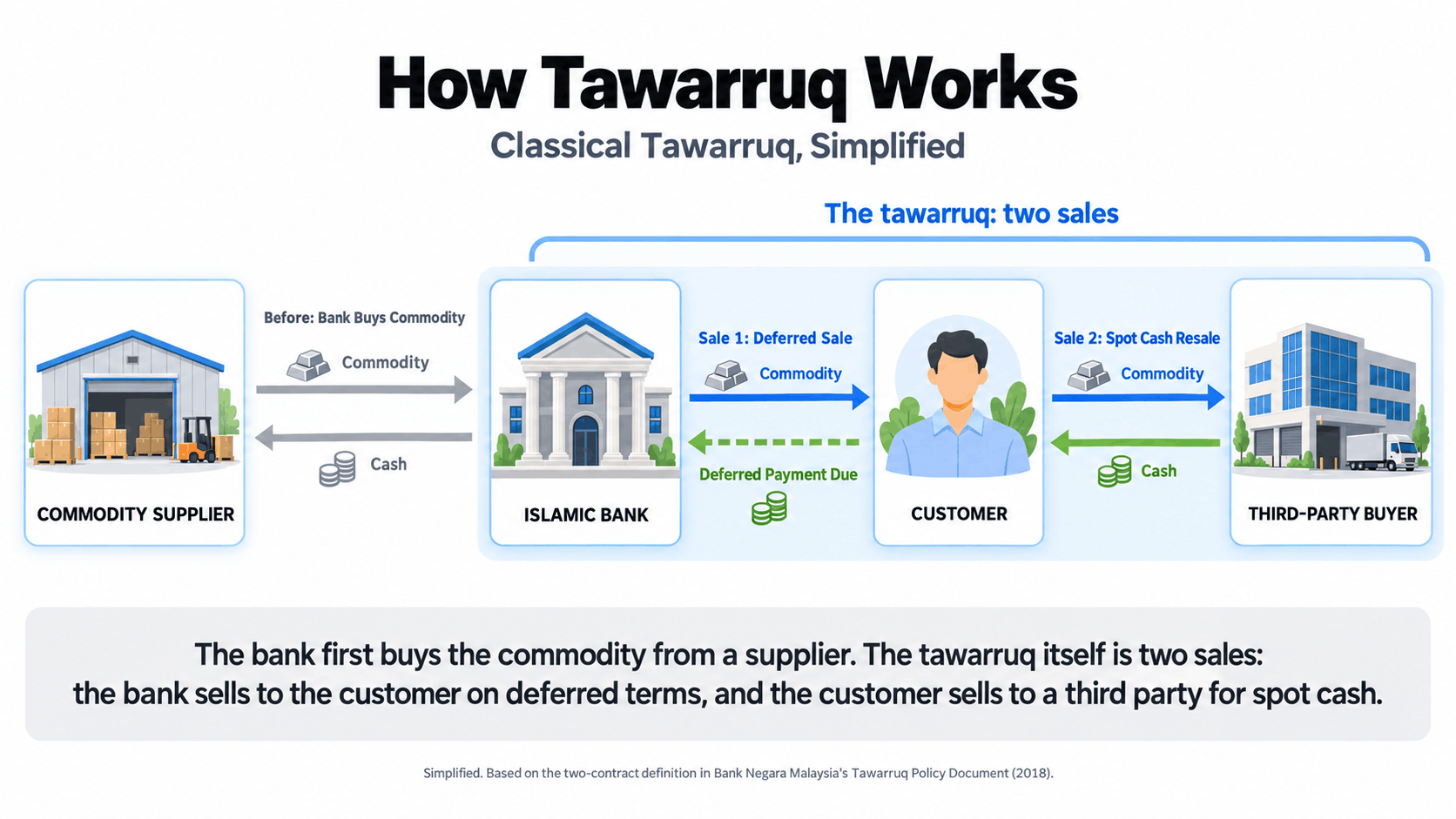
Under paragraph 9.1 of Bank Negara Malaysia’s 2018 Tawarruq Policy Document, a tawarruq consists of two sale and purchase contracts:
- A seller sells an asset to a purchaser on a deferred basis.
- The purchaser sells the same asset to a third party on a cash and spot basis.
Paragraph 11.2 adds that the seller in the first sale may not be the purchaser in the second.
The literature distinguishes two forms by who handles that resale:
- Classical tawarruq: the purchaser conducts the resale independently.
- Organised tawarruq (al-tawarruq al-munazzam): a financial institution arranges or coordinates the resale.
How each body treats the arrangement depends on its own instrument, and the terms are not used consistently across standards.
Where Do the Standard-Setting Bodies Stand on Tawarruq?
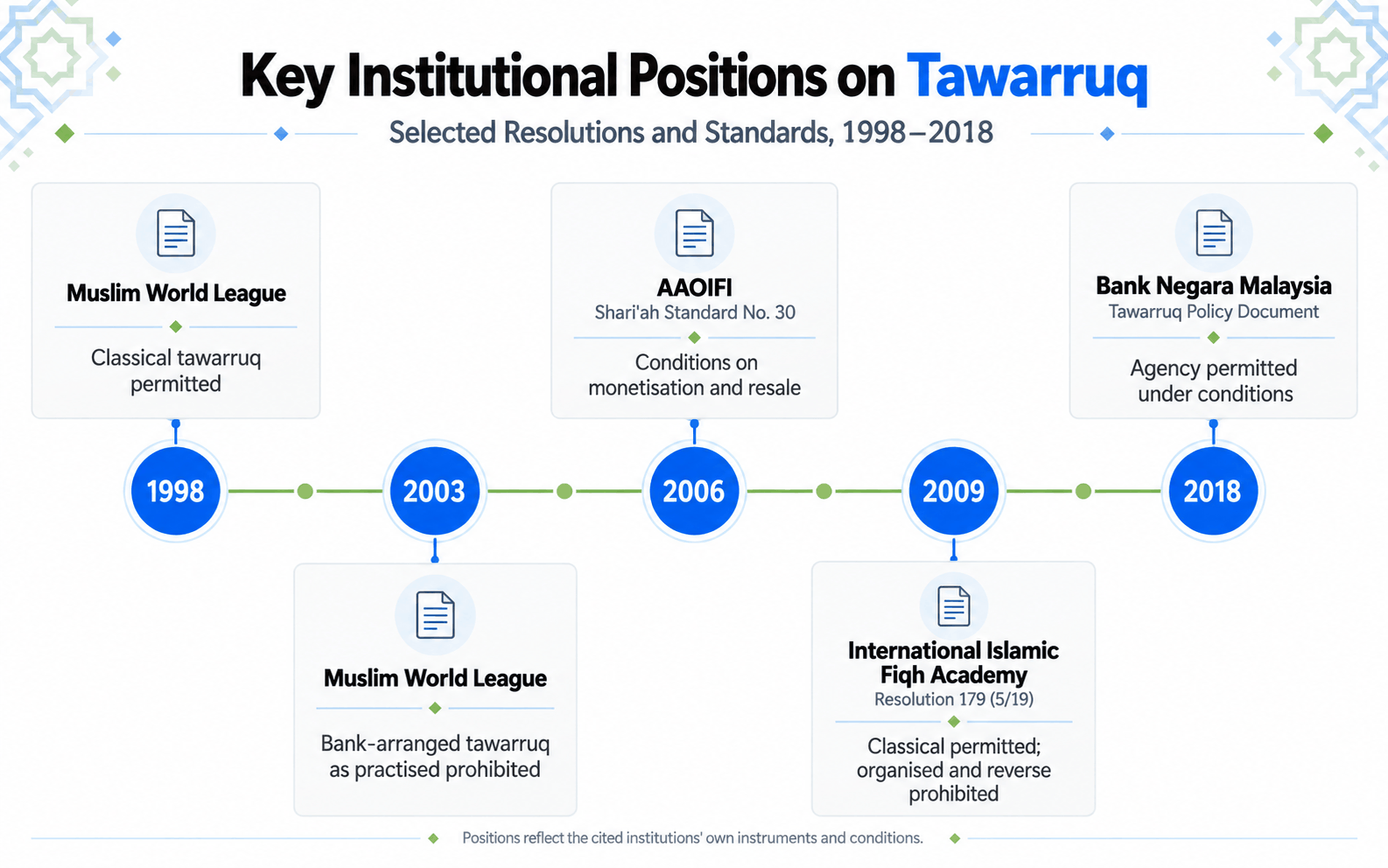
IIFA expressly permits classical tawarruq where sale conditions are met and prohibits the structured and inverse forms defined in its 2009 resolution.
AAOIFI and BNM address similar transactions through different standards, with materially different conditions on agency and resale.
The table compares what each institution published, not whether any institution is correct.
The distinction between classical, organised and reverse tawarruq is drawn in IIFA Resolution 179 (5/19), whose English text uses the terms “classic”, “structured” and “inverse” tawarruq.
In the reverse form, the institution rather than the client is the party seeking cash. Bank Negara Malaysia’s policy document does not use these categories.
| Body | Instrument | Year | Client resells independently | Resale arranged by institution or its agent | Where to read it |
|---|---|---|---|---|---|
| Islamic Fiqh Council, Muslim World League (MWL) | 15th and 17th session resolutions, Makkah | 1998; 2003 | Permitted (1998) | Organised tawarruq as practised by banks declared impermissible (2003) | Dates cited in Ali and Hassan (2020), free |
| AAOIFI | Shari’ah Standard No. 30, Monetization (Tawarruq) | 2006 | Permitted subject to the standard’s conditions | Client may not appoint the institution or its agent to resell, except where regulations permit no other route and only after receipt (4/7); institution may not arrange a third-party proxy to sell for the client (4/8) | I-FIKR (free); AAOIFI e-standards (online access) |
| Dubai Islamic Bank | Fatwa: Prohibition of Al-Tawarruq Al-Munazzam in 2007 | 2007 appears in title | Not established by the title | Record title refers to prohibition; scope needs full-text review | I-FIKR (Premium) |
| International Islamic Fiqh Academy | Resolution 179 (5/19), 19th session, Sharjah, 26 to 30 April 2009 | 2009 | Permitted where the conditions of sale are met | Organised and reverse tawarruq prohibited | I-FIKR (Premium); the Academy’s published text |
| Bank Negara Malaysia | Tawarruq policy document, BNM/RH/PD 028-8 | 2018 | Permitted (two-sale definition, paragraph 9.1) | Agency and dual agency permitted under conditions | I-FIKR (free); BNM |
AAOIFI Shari’ah Standard No. 30 addresses monetisation without adopting IIFA’s classical, organised and reverse categories. Two clauses govern who may conduct the resale:
- Clause 4/7: the client may not authorise the selling institution or its agent to conduct the resale. A narrow exception applies where regulations leave no other route and the client has first received the commodity.
- Clause 4/8: the institution may not arrange a third party to resell the commodity for the client.
Researchers can consult the I-FIKR standard record and AAOIFI’s official standards portal.
Three points matter when citing the table:
- Dubai Islamic Bank (2007): I-FIKR catalogues the fatwa Prohibition of Al-Tawarruq Al-Munazzam in 2007 (Premium). Its title should not be used to infer the full scope or conditions of the bank’s position without the underlying text.
- IIFA and the MWL: the IIFA Council reviewed the MWL resolutions before adopting Resolution 179 (5/19) in 2009.
- Malaysia and IIFA: the Malaysian policy takes a different approach from IIFA’s 2009 classification, which matters when a researcher compares rulings from separate jurisdictions or studies an individual bank’s Shariah approval.
The issuing bodies publish their own instruments. I-FIKR allows researchers to move between those instruments, bank fatwa records and related academic literature without treating any repository summary as a substitute for the original ruling.
How Have Bank Shariah Boards Applied Tawarruq in Their Fatwas?
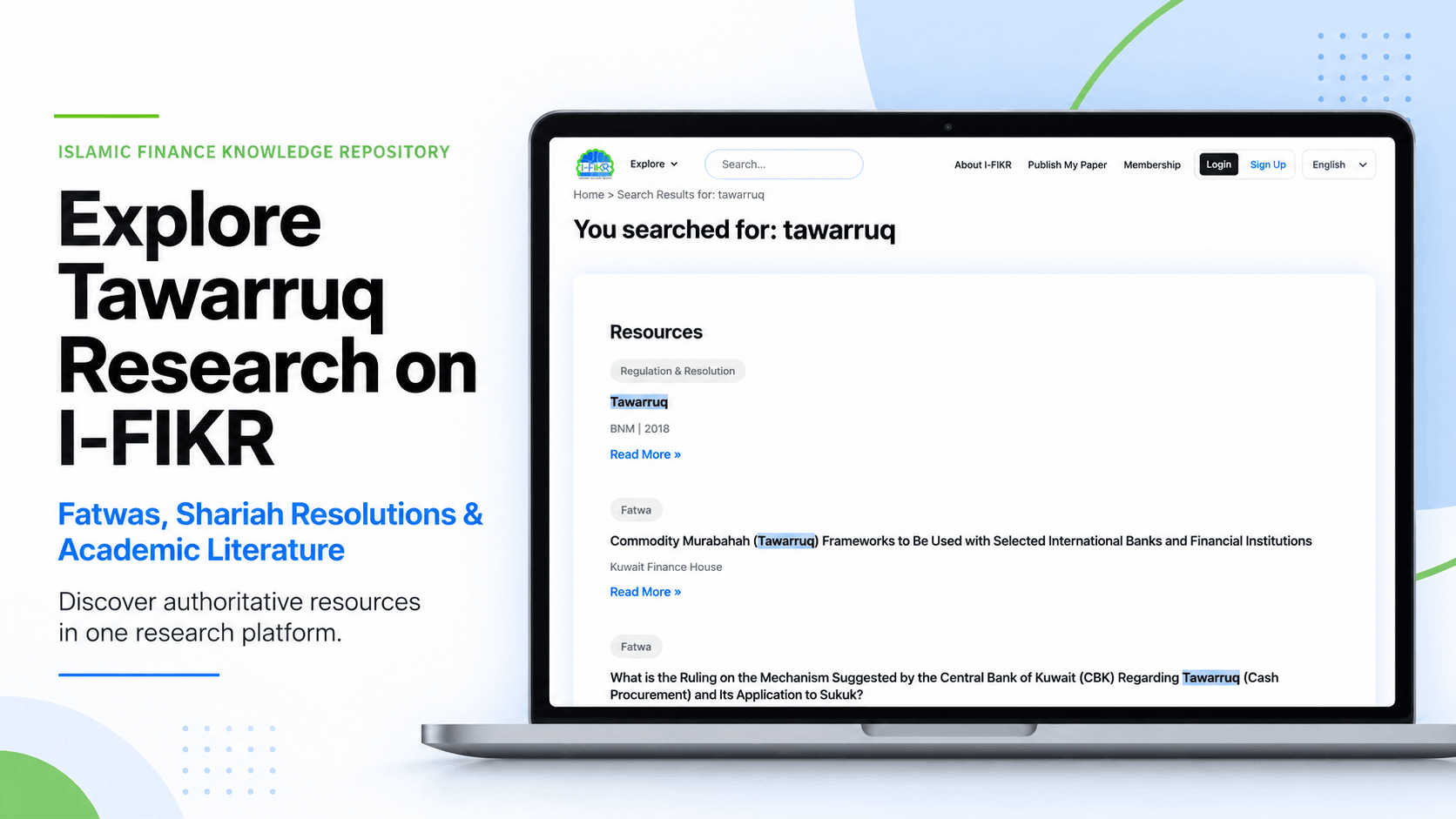
I-FIKR catalogues tawarruq-related fatwa records attributed to Shariah boards at institutions including Kuwait Finance House (KFH), Arab Banking Corporation and Dubai Islamic Bank.
Most address a single operational question: which commodity may be used, who may resell it, which counterparties are acceptable, and what the cash may be used for.
The table compares what each institution published, not whether any institution is correct.
| Question addressed | Record | Issuer | Access |
| Choice of commodity | Tawarruq Using Cement as the Commodity | Kuwait Finance House | Premium |
| The resale | Tawarruq When the Bank Does Not Involve Itself in the Customer’s Resale of the Good | Kuwait Finance House | Premium |
| Counterparty | Tawarruq With a Conventional Bank | Arab Banking Corporation | Premium |
| Counterparty | Commodity Murabahah (Tawarruq) Frameworks to Be Used with Selected International Banks and Financial Institutions | Kuwait Finance House | Premium |
| Purpose of the cash | Is it permissible to conduct Tawarruq procedure for a company that intends to settle a previous interest-based debt? | Kuwait Finance House | Premium |
Notes on reading these records:
- The resale (KFH): the record concerns the bank’s non-involvement in the client’s second sale, the step on which the instruments in the table above differ.
- Counterparties: the KFH frameworks record concerns arrangements with international counterparties, while the Arab Banking Corporation record addresses tawarruq with a conventional bank.
- AAOIFI clause 3/2: separately restricts monetisation involving conventional banks when the funds would be used for interest-based lending; this does not establish the outcome of the Arab Banking Corporation fatwa.
A fatwa’s catalogue title identifies the question examined, but does not necessarily disclose the full reasoning, conditions or scope of the Shariah board’s ruling. Researchers should read each Premium record before citing a bank’s substantive position.
Need the regulator’s own text rather than a bank’s application of it? I-FIKR’s Regulation & Resolution collection holds BNM policy documents, AAOIFI Shari’ah Standards and compiled Shariah Advisory Council resolutions.
What Governs Tawarruq in Malaysian Islamic Banking?
For Malaysian Islamic financial institutions, the governing instrument is BNM/RH/PD 028-8. The provisions most relevant to researchers:
- Status: issued and effective on 28 December 2018; sets Shariah requirements and operational expectations for Malaysian Islamic financial institutions.
- Contract form (paragraph 10.3): the sale and purchase contract within a tawarruq may take the form of murabahah or musawamah.
- Agency (paragraphs 16 and 17): wakalah (agency) and dual agency may be used, subject to the document’s transaction-sequencing and other conditions.
Commodity murabahah is the market name commonly used for tawarruq in Malaysia, though the terms are not identical.
The Bursa Suq Al-Sila’ commodity platform is a further focus of Malaysian scholarship. Research examines whether documented commodity ownership, possession, resale and agency arrangements address the concerns raised about organised tawarruq in Islamic banking.
What Does the Research on Tawarruq Practice Examine?
I-FIKR’s research records examine the legal arguments surrounding IIFA’s 2009 decision, the operation of commodity platforms and the application of tawarruq in Islamic banking products.
These papers also distinguish a transaction’s formal contractual design from the way its sales and agency steps are executed.
- The 2009 ruling. Rafe Haneef (2009), IRP 2: Is the Ban on “Organised Tawarruq” the Tip of the Iceberg?, Premium. Haneef examines the arguments of the opponents and proponents of tawarruq to assess the IIFA ruling, and places it within wider critiques of contemporary Islamic finance contracts.
- The commodity platform. Asyraf Wajdi Dusuki (2010), IRP 10: Can Bursa Malaysia’s Suq al-Sila’ (Commodity Murabahah House) Resolve the Controversy over Tawarruq?, Premium. Dusuki judges the platform Bursa Malaysia launched in 2009 a commendable initiative while identifying unresolved Shariah matters, and argues that its use should be weighed against genuine need. Bursa Malaysia describes the platform’s role in tawarruq transactions in its own explainer.
- Dusuki, Muhammad Mahbubi Ali and Yulizar D. Sandrego (2013), IRP 49: The Application of Commodity Murabahah in Bursa Suq Al-Sila’ Malaysia vis-a-vis Jakarta Future Exchange Shariah Indonesia, Premium. IRP 49 identifies four Shariah issues in organised tawarruq: the commodity, possession and delivery, prearrangement, and agency.
- Practice in Malaysian banks. Mohammad Mahbubi Ali and Rusni Hassan (2020), Survey on Sharīʿah non-compliant events in Islamic banks in the practice of tawarruq financing in Malaysia, ISRA International Journal of Islamic Finance 12(2), DOI, free. Surveying 16 Malaysian Islamic commercial banks, Ali and Hassan found that some tawarruq practices might not comply with Shariah, mainly through improper sequencing of contracts. Boards of directors or management influenced certain Shariah decisions, particularly on the treatment of non-halal income.
- Muhammad Izzul Syahmi, Mohammad Taqiuddin Mohamad and Mohd Anuar Ramli (2022), Experts’ views on hiyal in Malaysian Islamic banks: the case of tawarruq-based deposit products, ISRA IJIF 14(3), free. Drawing on expert interviews, the authors report that Malaysian Islamic banks adopted tawarruq munazzam for deposit products because of banking-system constraints and customer preferences, and call for new contracts to be developed.
Researchers who need the complete Premium fatwas and research papers can explore the collection through I-FIKR’s three-day free trial; the platform states that new users do not need a payment card to activate it.
What Alternatives to Tawarruq and Transition Paths Have Been Discussed?
Two instruments name alternatives:
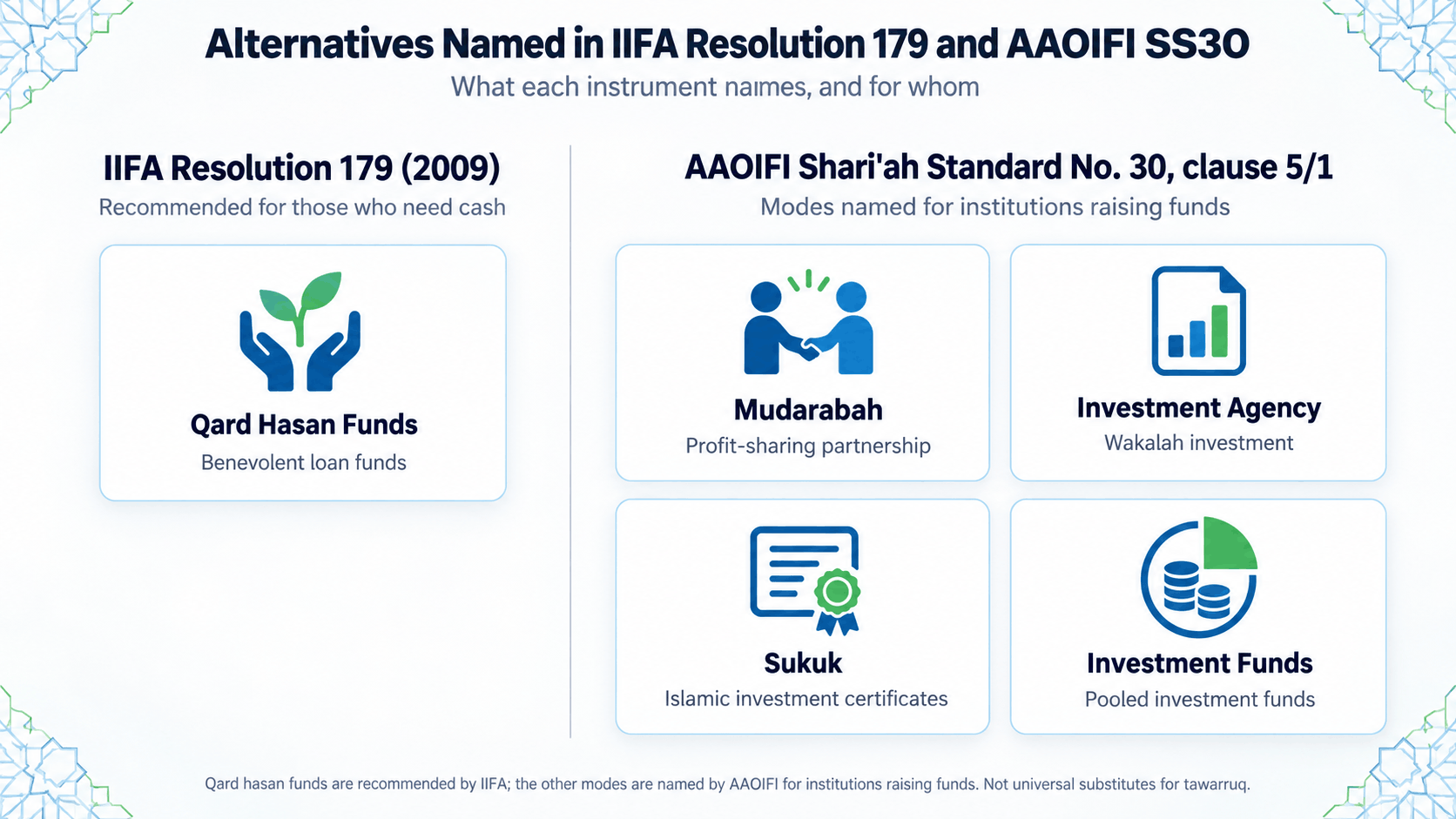
- IIFA Resolution 179 (5/19) recommends that Islamic financial institutions consider establishing special qard hasan funds, so that those who need cash are not forced into prohibited tawarruq.
- AAOIFI Shari’ah Standard No. 30, clause 5/1, states that monetisation is not a mode of investment or financing. It points institutions to modes such as mudarabah, investment agency, sukuk and investment funds, and allows monetisation for their own liquidity only when a shortage threatens to interrupt operations. The full standard is free on I-FIKR.
Why Use I-FIKR for Islamic Finance Research?
I-FIKR brings authoritative Shariah and Islamic finance references together in one platform.
- Institutionally curated: Content is curated by ISRA Institute and INCEIF University, not crowdsourced.
- Regulatory sources in one place: Documents from Bank Negara Malaysia (BNM), the Securities Commission Malaysia (SC) and AAOIFI sit alongside fatwas, journals and industry reports.
- Arabic made accessible: Selected Arabic materials are translated into English.
- Start free: Registration costs nothing, and new accounts get a three-day Premium trial with no payment card.
- Access for teams: The Corporate Plan offers institutional accounts, onboarding and usage reports on request.
Frequently Asked Questions
How does tawarruq differ from bay al-inah?
Clause 4/5 of AAOIFI Shari’ah Standard No. 30 requires the cash sale in monetisation to go to someone other than the original seller. Bay al-inah sells the commodity back to the party it was bought from.
Is commodity murabahah the same as tawarruq?
What did IIFA Resolution 179 decide?
IIFA Resolution 179 (5/19), adopted in Sharjah in April 2009, permits classical tawarruq that meets the conditions of sale, prohibits organised and reverse tawarruq, and recommends qard hasan funds.
Did AAOIFI prohibit organised tawarruq?
Which BNM document governs tawarruq in Malaysia?
What is Bursa Suq Al-Sila'?
Where can I read the primary documents on tawarruq?
I-FIKR lists the BNM 2018 policy and AAOIFI Shari’ah Standard No. 30 as free resources, while its IIFA Resolution 179 record is labelled Premium. The IIFA resolution is also publicly available from the issuing Academy, and AAOIFI provides online access to its standards through its official portal.
I-FIKR hosts these materials, with English translations of selected Arabic records, and does not issue Shariah rulings. Readers should consult the issuing body’s own publication for the authoritative text.
Shariah review and compliance teams that need shared access can arrange institutional accounts, with onboarding and usage reports on request, through the I-FIKR Corporate Plan.