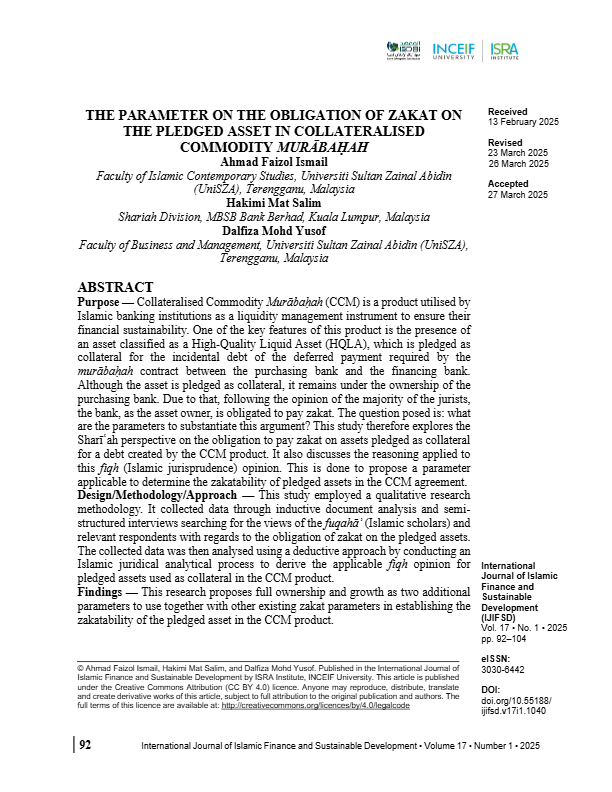
Purpose — Collateralised Commodity Murābaḥah (CCM) is a product utilised by Islamic banking institutions as a liquidity management instrument to ensure their financial sustainability. One of the key features of this product is the presence of an asset classified as a High-Quality Liquid Asset (HQLA), which is pledged as collateral for the incidental debt of the deferred payment required by the murābaḥah contract between the purchasing bank and the financing bank. Although the asset is pledged as collateral, it remains under the ownership of the purchasing bank. Due to that, following the opinion of the majority of the jurists, the bank, as the asset owner, is obligated to pay zakat. The question posed is: what are the parameters to substantiate this argument? This study therefore explores the Sharīʿah perspective on the obligation to pay zakat on assets pledged as collateral for a debt created by the CCM product. It also discusses the reasoning applied to this fiqh (Islamic jurisprudence) opinion. This is done to propose a parameter applicable to determine the zakatability of pledged assets in the CCM agreement.
Design/Methodology/Approach — This study employed a qualitative research methodology. It collected data through inductive document analysis and semistructured interviews searching for the views of the fuqahāʾ (Islamic scholars) and relevant respondents with regards to the obligation of zakat on the pledged assets. The collected data was then analysed using a deductive approach by conducting an Islamic juridical analytical process to derive the applicable fiqh opinion for pledged assets used as collateral in the CCM product.
Findings — This research proposes full ownership and growth as two additional parameters to use together with other existing zakat parameters in establishing the zakatability of the pledged asset in the CCM product.
Originality/Value — This research discusses a grey area with respect to zakat obligations of business institutions. It proposes new elements to be taken into account by the institutions as their self-regulatory benchmark to ensure they contribute towards the sustainability of societal progress via the zakat instrument.
Practical Implications — These parameters are applicable as a self-regulatory benchmark for Islamic banks to ensure that they fulfil their responsibility as institutions that uphold Islamic values in their business. The findings also have the potential to be applied by regulators such as Bank Negara Malaysia and religious authorities in Malaysia as additional elements of zakat parameters for the financial institutions under its regulation.