
Murabahah is a cost-plus sale in which the seller discloses the acquisition cost and agreed profit. For researchers, the next question is often not what Murabahah means, but which institutional sources address a particular Shariah or operational issue.
This I-FIKR guide groups relevant records by nine research areas and 31 subtopics, from purchase promises and asset possession to fees, currency, guarantees and early settlement. Each resource title links to its I-FIKR record.
Key Takeaways
- Find resources by issue: Nine research areas and 31 subtopics.
- Go to primary records: Each linked title opens its I-FIKR resource page.
- Read titles carefully: A fatwa title identifies a question, not its ruling.
- Free and Premium research path: Start with free standards and scholarship, then investigate specific Premium Fatwa records.
- Check scope: Classical Murabahah and MPO; Tawarruq structures and Sukuk are separate.
How to Use This Murabahah Research Directory
- Begin with a free reference below to understand the relevant framework.
- Choose a research area and subtopic from the index.
- Open the listed institutional Fatwa records for the specific question you are researching.
- Confirm the issuing body, access conditions, full text and applicable standard before citing any Shariah conclusion.
Scope: The directory focuses on classical Murabahah, including Murabahah to the Purchase Orderer (MPO). It excludes records explicitly about Commodity Murabahah/Tawarruq and Murabahah Sukuk. A record mentioning a commodity is not automatically a Tawarruq record.
Free Research Starting Points
Start with the free and publicly available references below. These resources provide regulatory or scholarly context, but do not replace a full institutional Fatwa when assessing a specific transaction.
Starting resource | Resource type | Best used for |
Regulation & Resolution (Free on I-FIKR) | Purchase undertakings, agency, ownership, costs and payment questions where this standard is applicable. | |
Regulation & Resolution (Free on I-FIKR) | Malaysian Murabahah requirements and practical terminology; confirm current applicability and amendments. | |
Islamic Banks’ Profit and Violations in Murābaḥah Financing (Madbash, 2024) | English Journal (Free on I-FIKR) | Academic discussion of Murabahah financing, bank profitability and potential compliance issues. |
Keeping a Promise and Murābaḥah to the Purchase Orderer (IIFA Resolution Nos. 40–41) | Official institutional resolution (external website) | The Academy’s published text on purchase promises and MPO. |
Browse Murabahah Research Topics
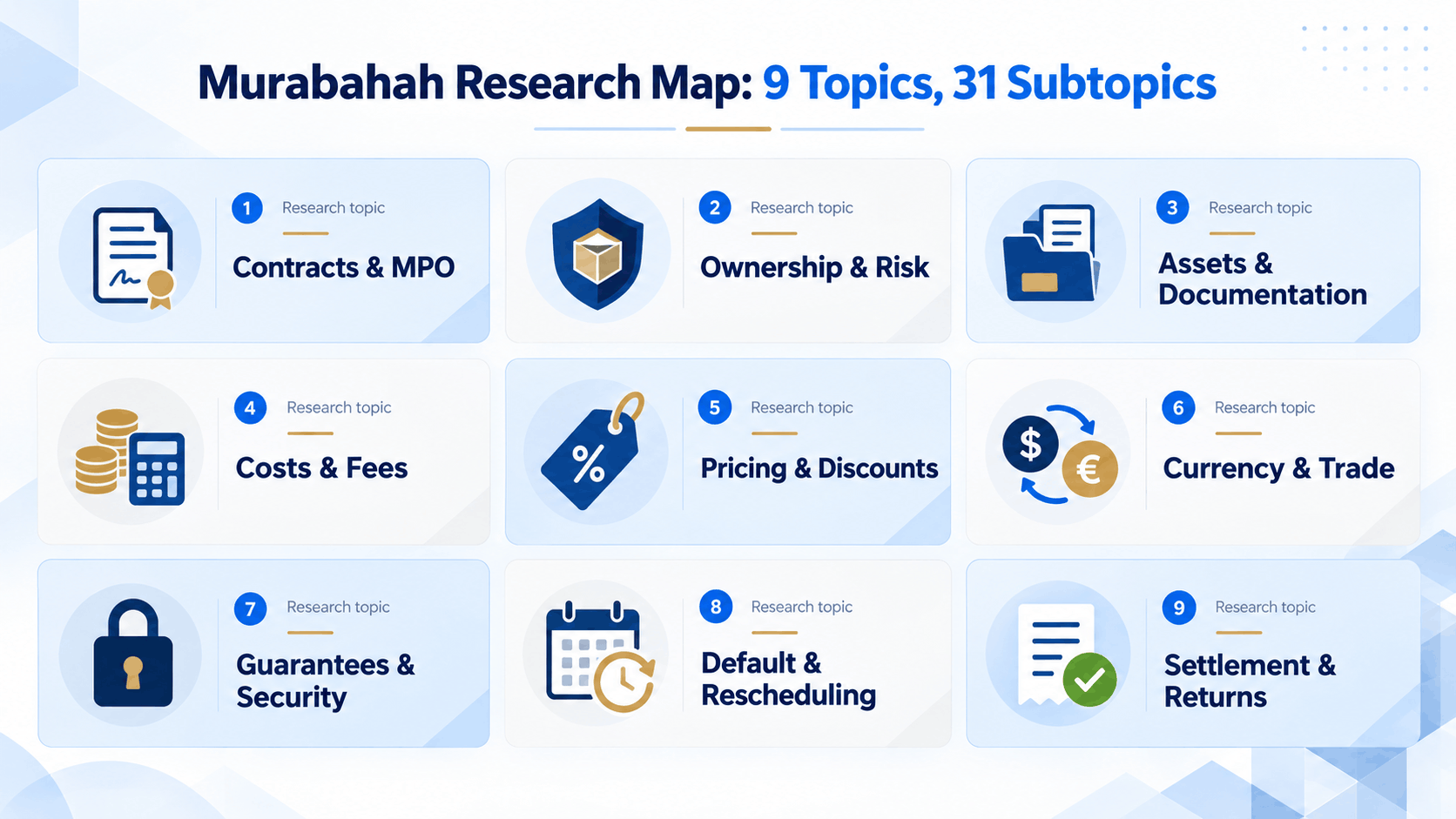
Research area | What you can investigate |
1. Contract foundations and Murabahah to the Purchase Orderer | General conditions and contract procedures, binding promises and purchase undertakings, prior agreements with suppliers |
2. Ownership, possession and pre-delivery risk | Acquisition and actual or constructive possession, damage, loss and delayed delivery, registration and legal title |
3. Asset eligibility, specification and trade documents | Asset identification and inspection, bills of lading and shipping documentation, real estate, vehicles and equipment |
4. Acquisition costs, charges and fees | Storage and demurrage, commissions and banking fees, insurance and takaful costs |
5. Profit, price disclosure and supplier discounts | Profit margins and sale-price calculations, supplier discounts and incentives, price disclosure and revisions |
6. Foreign currency and international trade | Exchange rates and transaction currencies, imports and documentary credits, asset revaluation |
7. Commodity soundness and payment security | Commodity soundness and defects, kafalah, collateral and guarantees, purchase deposits and earnest money |
8. Late payment and debt rescheduling | Default, delays and penalties, rescheduling and instalments |
9. Early settlement, cancellation and returns | Early settlement and ibra’, cancellation and termination, returns and subsequent transactions |
1. Contract foundations and Murabahah to the Purchase Orderer
Begin here for general contract procedures, the customer’s promise and the bank’s purchase arrangement. These records show how institutions frame the transaction before any Murabahah sale is concluded.
Read openly first: IIFA Resolutions 40–41 on promises and MPO (official public resolution), then compare the relevant Premium Fatwa questions below.
How to read the resource lists: The names in italics after each linked title are the authors or institutions listed on each I-FIKR record. Some records list more than one institution. They identify a source, not a verified Shariah ruling.
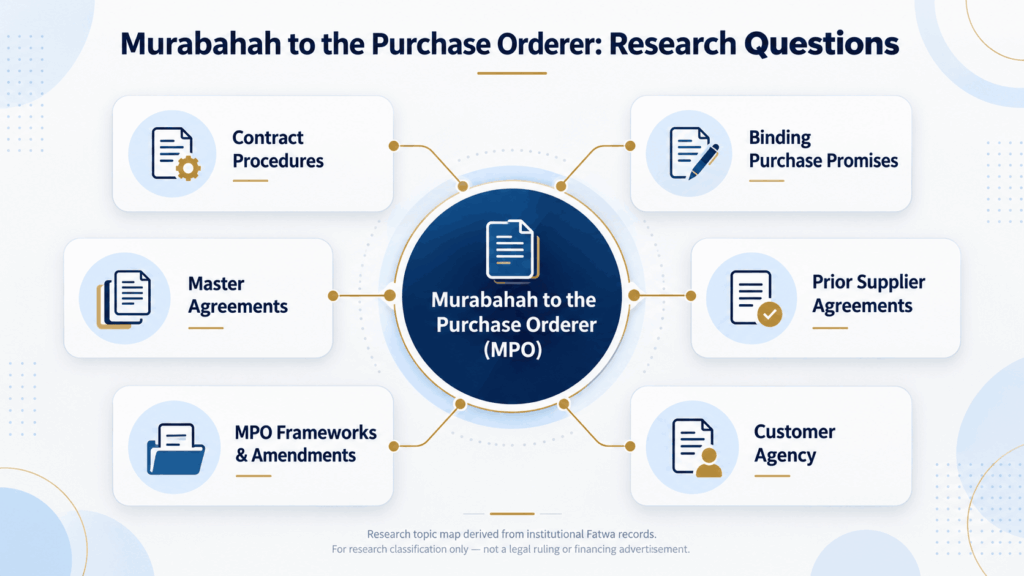
General conditions and contract procedures
Foundational documentation and process questions.
Related I-FIKR Fatwas (Premium access):
- General Provisions of Murabaha — Islamic Fiqh Academy India, Qatar Islamic Bank, Sudan Islamic Bank, Faisal Islamic Bank
- Steps and Procedures of Murabaha Contract — Faisal Islamic Bank, Kuwait Finance House, Qatar Islamic Bank, Al-Rajhi Banking and Investment Corporation
- What Are the Rules Regarding Conditions Governing Murabahah Contract? — Kuwait Finance House
Binding promises and purchase undertakings
Questions on the customer’s undertaking and the nature of a binding promise.
Related I-FIKR Fatwas (Premium access):
- The Binding Nature of Promise in Murabahah Transactions — Organization of Islamic Conference (OIC), Kuwait Finance House, Al Baraka Banking Group, Islamic Banks
- Is it Allowed to stipulate on the customer to sign a binding promise to purchase the goods in a Murabahah contract? — Kuwait Finance House
- Resolution Nos. 40–41 (2/5 and 3/5) Keeping a Promise and Murābaḥah to the Purchase Orderer — The International Islamic Fiqh Academy
Prior agreements with suppliers
Cases where the prospective buyer may already have a relationship or contract with the original seller.
Related I-FIKR Fatwas (Premium access):
- A Customer Approaches the Bank for Murabahah after Having Concluded an Agreement with the Exporter — Kuwait Finance House
- A Pre-Existing Contract Between the Original Seller and the Purchase Undertaker in Murabahah — Kuwait Finance House
- How to Terminate a Pre-Existing Contract in Order to Effect a Murabahah Sale? — Kuwait Finance House
Agency and purchase authorisation
Whether and how customers or other agents take part in acquiring the asset.
Related I-FIKR Fatwas (Premium access):
- General Provisions of Agency in Murabahah Transactions — Al Baraka Banking Group
- Appointment of the Purchase Orderer as an Agent in Murabahah Transactions — Al Baraka Banking Group
- Is it Allowed in a Murabahah Sale to Appoint the Client as an Agent to Purchase the Goods from the Supplier and Authorize him to Sell the Goods to Himself at the Agreed Price? — Kuwait Finance House
MPO frameworks and contract amendments
Titles tracing changes to Murabahah to the Purchase Orderer (MPO) frameworks.
Related I-FIKR Fatwas (Premium access):
- Murabahah to the Purchase Order Framework After Amendments — Al Baraka Banking Group
- What’s the Shariah Opinion Regarding the Proposed Amendments to the Murabahah to the Purchase Order Contract Concerning the Rates, Commissions, Currency Differences and Postal Fees? — Al Baraka Banking Group
- Development of a New Contract in the form of Murabahah Partnership Along with the Murabahah Transaction to the Purchase Orderer — Al Baraka Banking Group
Master agreements and other contract structures
General amendments and master or repeat contract arrangements.
Related I-FIKR Fatwas (Premium access):
- Amending the Articles of Murabaha Contracts — Jordan Islamic Bank for Finance and Investment
- Repetitive Murabaha within a Specific Ceiling — Kuwait Finance House, Islamic Bank of Jordan
- Approval for the Company to enter into a master murābaḥah agreement — Al Rajhi Banking and Investment Corporation
2. Ownership, possession and pre-delivery risk
These sources help researchers locate questions about whether the bank acquired and possessed the asset, and which party faced risk before delivery. The titles are research questions, not determinations that a specific document or arrangement is sufficient.
Free reference: AAOIFI Shari’ah Standard No. 8 provides a starting framework for asset possession and risk where adopted.
Acquisition and actual or constructive possession
Holding or controlling goods before a Murabahah resale.
Related I-FIKR Fatwas (Premium access):
- Selling Goods on Murabaha before Possession — Qatar Islamic Bank
- Goods not Possessed or Received in Murabahah Transactions — Faisal Islamic Bank, Kuwait Finance House, Islamic Bank of Western Sudan
- A Discrepancy is found in Murabahah Goods That Were Sold before Possessing Them — Kuwait Finance House
Damage, loss and delayed delivery
Damage to goods or loss while the asset is being acquired or delivered.
Related I-FIKR Fatwas (Premium access):
- Liability of Goods Damage Prior to Delivery in Murabahah Transactions — Kuwait Finance House, Jordan Islamic Bank for Finance & Investment, Qatar Islamic Bank
- Who Bears the Loss in a Murabahah to the Purchase Order Financing Due to an Accident that Occurred Before the Goods Are Delivered to the Client? — Al Baraka Banking Group
- Damages Resulting from Delay of goods Delivery in Murabahah Transactions — Qatar Islamic Bank
Registration and legal title
Questions concerning the registration of an asset in the bank’s name.
Related I-FIKR Fatwas (Premium access):
- To Keep the Registration in the Name of the Bank in Murabahah Transactions — Qatar Islamic Bank
- Is it Permissible in a Murabahah to the Purchase Order Financing that the Asset Remains Registered in the Bank Name Until the Client Fully Pays the Price? — Al Baraka Banking Group
- Is it a Condition in a Vehicle Financing Based on Murabahah to the Purchase Order that the Vehicle Must Be Registered Under the Bank Name Before the Execution of the Contract? — Al Baraka Banking Group
3. Asset eligibility, specification and trade documents
Choose this area when researching what may be sold, how clearly it must be described, and which documents accompany the transaction.
Asset identification and inspection
Specification and inspection issues where the asset is not sufficiently described.
Related I-FIKR Fatwas (Premium access):
- Ignorance of the Commodity Specifications in Murabahah Transactions — Kuwait Finance House
- Please provide Shariah opinion in case it is stipulated that assets which are the subject matter of Murabaha transaction should be made known and identified? — Faisal Islamic Bank
- Is Good Inspection Obligatory in Both Musawama and Murabaha Contracts? — Kuwait Finance House
Bills of lading and shipping documentation
Imports, document arrival and evidence associated with possession or delivery.
Related I-FIKR Fatwas (Premium access):
- Bills of Lading in Murabahah Transactions — Qatar Islamic Bank
- Arrival of the Goods Prior to the Arrival of the Documents in Murabahah Transactions — Kuwait Finance House, Qatar Islamic Bank
- Non-Receipt of Invoices in the Name of the Bank in Murabahah Transactions — Qatar Islamic Bank
Real estate, vehicles and equipment
Asset-specific examples involving land, buildings and vehicles.
Related I-FIKR Fatwas (Premium access):
- Buying A Portion Of A Land Through Murabahah — Faisal Islamic Bank
- Buying and Selling of Lands without Registration on Murabahah Basis — Jordan Islamic Bank for Finance and Investment
- What’s the Shariah Opinion Regarding the Purchase of Vehicles from Suppliers in Order to be Sold to Clients on the Basis of Murabahah? — Al Baraka Banking Group
Shares, services and other asset types
Records on shares, services and other asset types.
Related I-FIKR Fatwas (Premium access):
- Murabaha in Shares — Al Rajhi Banking and Investment Corporation
- Services of Charities on Murabahah Basis — Kuwait Finance House
- Labor Services on Murabahah Basis — Kuwait Finance House, Islamic Bank of Western Sudan
Exploring Shariah questions beyond Murabahah? Browse I-FIKR’s Fatwa collection for institutional fatwa records across Islamic finance contracts.
4. Acquisition costs, charges and fees
This group focuses on what the selling institution may include in its disclosed acquisition cost.
Free reference: BNM’s Murabahah Policy Document offers Malaysian policy context for costs and price disclosure. The Premium records below raise specific operational questions.
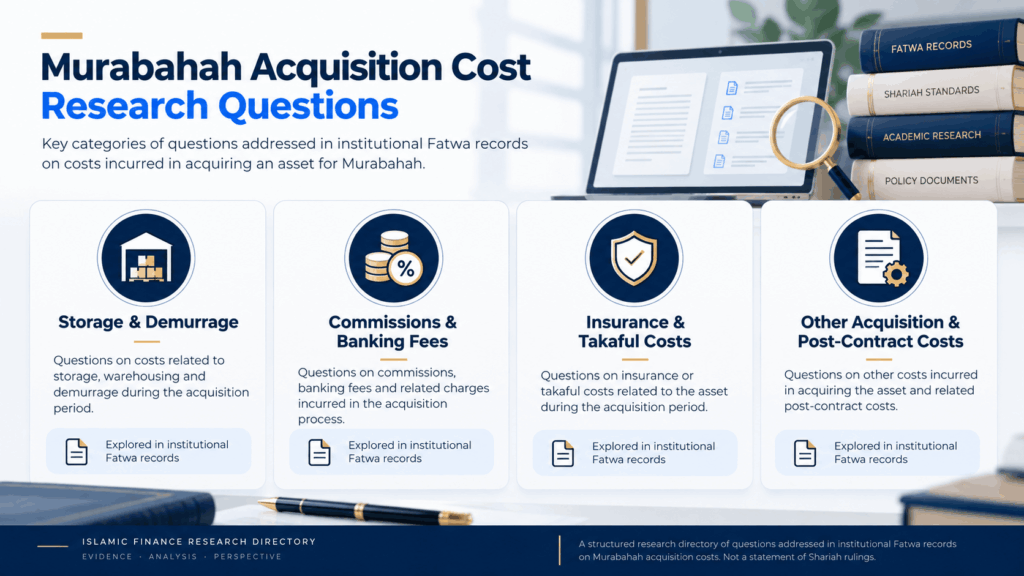
Storage and demurrage
Charges associated with storing goods or delays in clearing or collecting them.
Related I-FIKR Fatwas (Premium access):
- Commodity Storage Expenses and Demurrage Penalty etc. in Murabahah Transactions — Kuwait Finance House, Qatar Islamic Bank
- Adding Demurrage Charges to Commodity Cost in Murabahah Transactions — Kuwait Finance House
- Who Bears Unexpected Demurrage Charges in a Murabahah Contract? — Kuwait Finance House
Commissions and banking fees
Departmental commissions, agency fees and documentary-credit charges.
Related I-FIKR Fatwas (Premium access):
- Adding Bank Departmental Commissions to the Commodity Price in Murabahah Transactions — Kuwait Finance House
- Charging Distribution Agent Commission in Murabahah Transactions — Kuwait Finance House
- Can the Commission the Bank Charges for Opening an LC Be Added to the Expenses Included in the Murabahah Price? — Kuwait Finance House
Insurance and takaful costs
Insurance relating to the asset and allocation of charges in Murabahah transactions.
Related I-FIKR Fatwas (Premium access):
- Insurance of Sold Commodity in Murabahah Transactions — Dubai Islamic Bank, Qatar Islamic Bank
- Charging Against Insurance in Murabahah Transactions — Al Baraka Banking Group
Other acquisition and post-contract costs
Staff charges, assembly costs and expenses appearing after the contract.
Related I-FIKR Fatwas (Premium access):
- Inclusion of Bank Employees Costs in Murabahah Transactions — Kuwait Finance House
- Adding Assembly Expenses to the Cost of a Murabahah Deal for Machinery — Kuwait Finance House
- Charging of expenses which Appear after the Murabaha Contract — Kuwait Finance House
5. Profit, price disclosure and supplier discounts
Use this area to investigate profit calculation, cost transparency and price adjustments. The content of individual rulings requires access to the actual record.
Profit margins and sale-price calculations
How the sale price, margin or profit is determined and recorded.
Related I-FIKR Fatwas (Premium access):
- What is the Shariah View on How to Calculate the Sale Price in a Murabahah Transaction? — Kuwait Finance House
- Bases and Rules of Profit Determination in Murabahah Transactions — Kuwait Finance House
- How to Calculate the Selling Price in Murabahah — Kuwait Finance House
Supplier discounts and incentives
Supplier reductions received by the bank and questions about who benefits.
Related I-FIKR Fatwas (Premium access):
- Purchase Orderer Benefiting from Discount Granted to the Bank in Murabahah Transactions — Kuwait Finance House
- Must the Intermediate Seller in Murabahah Pass a Discount on to the Purchase Undertaker? — Kuwait Finance House
- What Is the Shariah Ruling on Receiving a Discount on Goods After They Have Been Sold to a Customer on Murabahah Basis? Is the Discount the Right of KFH of the Client? — Kuwait Finance House
Price disclosure and revisions
Questions concerning revising margins or the price stated in the contract.
Related I-FIKR Fatwas (Premium access):
- Amending the Profit Margin in Murabahah Transactions — Al Baraka Banking Group
- What is the Price to be Written in the Contract of Murabaha? — Kuwait Finance House
- Revision Of Murabahah Price — Arab Banking Corporation
6. Foreign currency and international trade
This section brings together cross-border Murabahah questions, including exchange rates, documentary credits and revaluation.
Exchange rates and transaction currencies
Which currency or exchange rate is relevant to a transaction.
Related I-FIKR Fatwas (Premium access):
- Which Day’s Exchange Rate Should Be Used in Charging the Customer in a Murabahah Sale? — Kuwait Finance House
- The Difference between the Currency of the Credit and the Currency of the Murabaha — Al Baraka Banking Group
- Can a Murabahah Deal Be Combined with a Foreign Currency Exchange? — Kuwait Finance House
Imports and documentary credits
Import and export transactions, including letters of credit and related procedures.
Related I-FIKR Fatwas (Premium access):
- Shariah opinion on Murabaha sales in the foreign trade — Kuwait Finance House
- In execution of Murabaha credits a documentary credit will be opened from the Bank for the benefit of the exporter. — Kuwait Finance House
- Murābaḥah financing of the importer customer — Mawarid Finance
Asset revaluation
Questions about reassessing an asset’s recorded value.
Related I-FIKR Fatwas (Premium access):
- Re-evaluation of Commodity in Murabahah Transactions — Egypt Islamic Bank
7. Commodity soundness and payment security
These are two different research questions: asset quality and defects concern the item being sold; security and guarantees concern contractual commitments or the debt.
Commodity soundness and defects
Quality, supplier performance and damaged goods.
Related I-FIKR Fatwas (Premium access):
- Client Guarantee for Commodity Soundness in Murabahah Transactions — Al Baraka Banking Group
- Murabahah: Guarantee by The Customer for Damages — Arab Banking Corporation
- What Is to Be Done in Murabahah about Anomalies in Delivery of the Subject of the Sale? — Kuwait Finance House
Kafalah, collateral and guarantees
Third-party guarantees, pledges and security over assets or deposits.
Related I-FIKR Fatwas (Premium access):
- Kafalah In A Murabahah Transaction — Al Baraka Banking Group
- Mortgage of Sold Goods in Murabahah Transactions — Dubai Islamic Bank
- Presentation of Cheques, Bonds and the Like as Guarantee in Murabahah Transactions — Kuwait Finance House, Al Baraka Banking Group
Purchase deposits and earnest money
Advance payments, deposits and related purchase undertakings.
Related I-FIKR Fatwas (Premium access):
- A Purchase Undertaking and Earnest Money for Murabahah — Kuwait Finance House
- The Buyer Pre-Signs a Murabahah Contract and Deposits an Advance Payment before the Seller Buys the Goods — Kuwait Finance House
- Can the Customer of a Murabaha Car Sale Use the Trade-In Price of His Old Car as the Down Payment for the New Car? — Kuwait Finance House
8. Late payment and debt rescheduling
This research trail separates late-payment problems from restructuring or changing payment schedules.
Free reference: BNM’s Murabahah Policy Document provides a Malaysian policy starting point. Specific Fatwa conclusions must still be checked in their full text.
Default, delays and penalties
Cases involving arrears, delayed payment and penalty clauses.
Related I-FIKR Fatwas (Premium access):
- Default in Payment of Murabaha Debt — Al Baraka Banking Group
- Delayed Payments In A Murabahah Contract — Al Barakah of Sudan
- A Penalty Clause for Delay in a Murabahah Contract — Kuwait Finance House
Rescheduling and instalments
Extending Murabahah periods or settling amounts in instalments.
Related I-FIKR Fatwas (Premium access):
- Extension of Murabahah Period — Arab Banking Corporation
- Solutions to Settle the Murabaha Debt — Kuwait Finance House, Al Baraka Banking Group
- Advancing Instalments in Murabahah Transactions — Kuwait Finance House, Qatar Islamic Bank, Islamic Bank of Western Sudan, International Islamic Bank
9. Early settlement, cancellation and returns
Find records about rebates (ibra’), termination and what happens when the goods or transaction are returned or changed.
Free reference: AAOIFI Shari’ah Standard No. 8 provides a starting point for studying settlement provisions where adopted. The cases below concern particular questions.
Early settlement and ibra'
Rebates or discounts connected with early payment.
Related I-FIKR Fatwas (Premium access):
- Is it allowed to give a discount (Ibra) to a client who bought a land through Murabahah and wishes to settle his debt early? — Kuwait Finance House
- Is it permissible to give an unconditional rebate to Murabahah costomers? — Kuwait Finance House
- Rounding up the Profit Rate if a Murabahah Deal is Paid off Earlier than Agreed — Kuwait Finance House
Cancellation and termination
Costs, entitlements and procedures if a Murabahah agreement is cancelled.
Related I-FIKR Fatwas (Premium access):
- Cancelling A Murabahah Contract — Faisal Islamic Bank
- Bearing of the Expenses Incurred before the Cancellation of Murabahah Transactions — Qatar Islamic Bank
- Eligibility of the Bank in Part of the Profit in the Event of the Cancellation of the Murabahah Transaction — Dubai Islamic Bank
Returns and subsequent transactions
Returning sold goods and subsequent contractual arrangements.
Related I-FIKR Fatwas (Premium access):
Standards, policy documents and further research
For a quick free reading path, see Free Research Starting Points above. The references below are grouped by source type. Standards, academic research and institutional Fatwas do not carry the same authority.
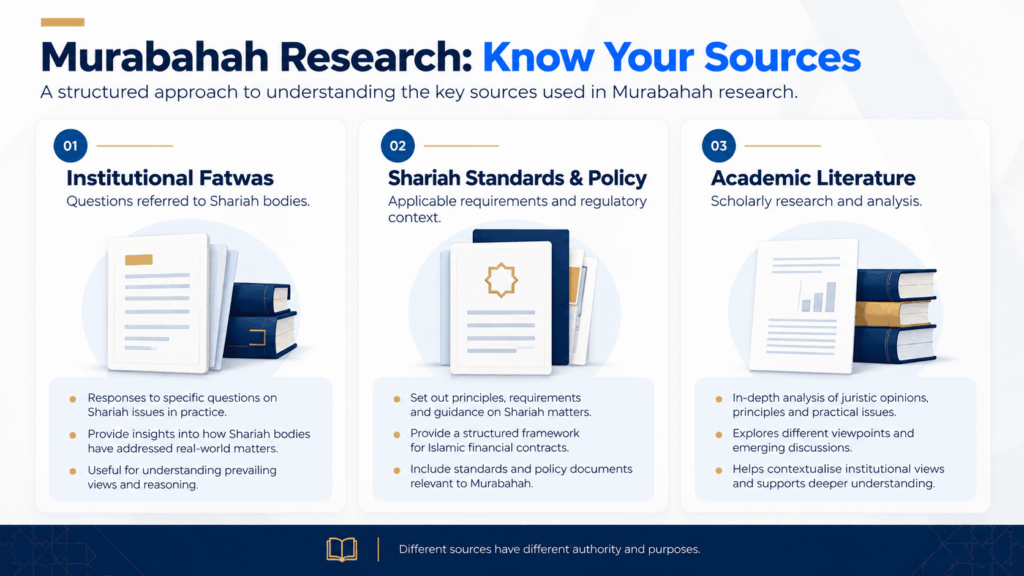
Shariah standards and Malaysian policy
- Regulation & Resolution (AAOIFI, Free): AAOIFI Shari’ah Standard No. (8): Murabahah (Revised Standard). Its publicly readable I-FIKR record includes the Murabahah standard text.
- Regulation & Resolution (Bank Negara Malaysia, Free): Murabahah. The 23 December 2013 Murabahah Policy Document (BNM/RH/STD 028-4) is also listed on BNM’s official policy-document index. Verify current applicability and related amendments before relying on it.
Academic literature and related research
- Research Paper (Import financing, Premium): IRP 115 – Istijrār: An Alternative Solution to Murābaḥah-based Import Financing Facilities under Letter of Credit-i in Malaysia. A related study exploring Istijrar as an alternative to Murabahah-based import financing.
- English Journal (Financing and bank performance, Free): ISLAMIC BANKS’ PROFIT AND VIOLATIONS IN MURĀBAḤAH FINANCING. The I-FIKR page displays the author, year and abstract.
Explore the source collections: Find additional publications in I-FIKR’s English Journal collection dan Research Paper collection. These collections cover a wider range of Islamic finance topics, not just Murabahah. To browse books, articles, industry reports and other categories, use All Resources.
Looking for the policy and Shariah standards behind these research questions? Explore I-FIKR’s Regulation & Resolution collection for related primary reference documents.
Why Use I-FIKR for Islamic Finance Research?
I-FIKR brings authoritative Shariah and Islamic finance references together in one platform.
- Institutionally curated: Content is curated by ISRA Institute and INCEIF University, not crowdsourced.
- Regulatory sources in one place: Documents from Bank Negara Malaysia (BNM), the Securities Commission Malaysia (SC) and AAOIFI sit alongside fatwas, journals and industry reports.
- Arabic made accessible: Selected Arabic materials are translated into English.
- Start free: Registration costs nothing, and new accounts get a three-day Premium trial with no payment card.
- Access for teams: The Pelan Korporat offers institutional accounts, onboarding and usage reports on request.
Frequently Asked Questions
What is murabahah in Islamic banking?
Murabahah (also spelt murabaha) is a sale with disclosed acquisition cost and mark-up (BNM 028-4, para 10.1). In MPO, a bank acquires an asset at a customer’s request before selling it to that customer on Murabahah terms.
Which BNM document governs murabahah?
BNM/RH/STD 028-4, issued on 23 December 2013 and effective from 1 January 2014, superseded the 2009 Shariah Parameter Reference 1 on Murabahah (para 7.1). Research citing the earlier document should take account of the later policy document and verify its current applicability.
How does murabahah differ from musawamah?
In Murabahah, the seller discloses acquisition cost and mark-up. In musawamah, the parties agree on a price without requiring disclosure of the seller’s cost, as State Bank of Pakistan’s guidance on Islamic modes of finance explains.
Kuwait Finance House also has a record on the difference between musawamah and murabahah.
Is commodity murabahah the same as murabahah?
Commodity Murabahah used for tawarruq involves a separate arrangement and is outside this guide. The article’s focus is classical Murabahah, including MPO.
Researchers studying Tawarruq should consult a separate resource collection rather than treat the two structures as interchangeable.
Can I read the murabahah fatwas without a subscription?
Visitors can view record titles and issuer details. The fatwas linked in this guide are Premium, while selected standards and research materials are publicly accessible.
The listed Premium fatwas can be accessed through the platform’s three-day trial or a Premium subscription, subject to the current access terms.