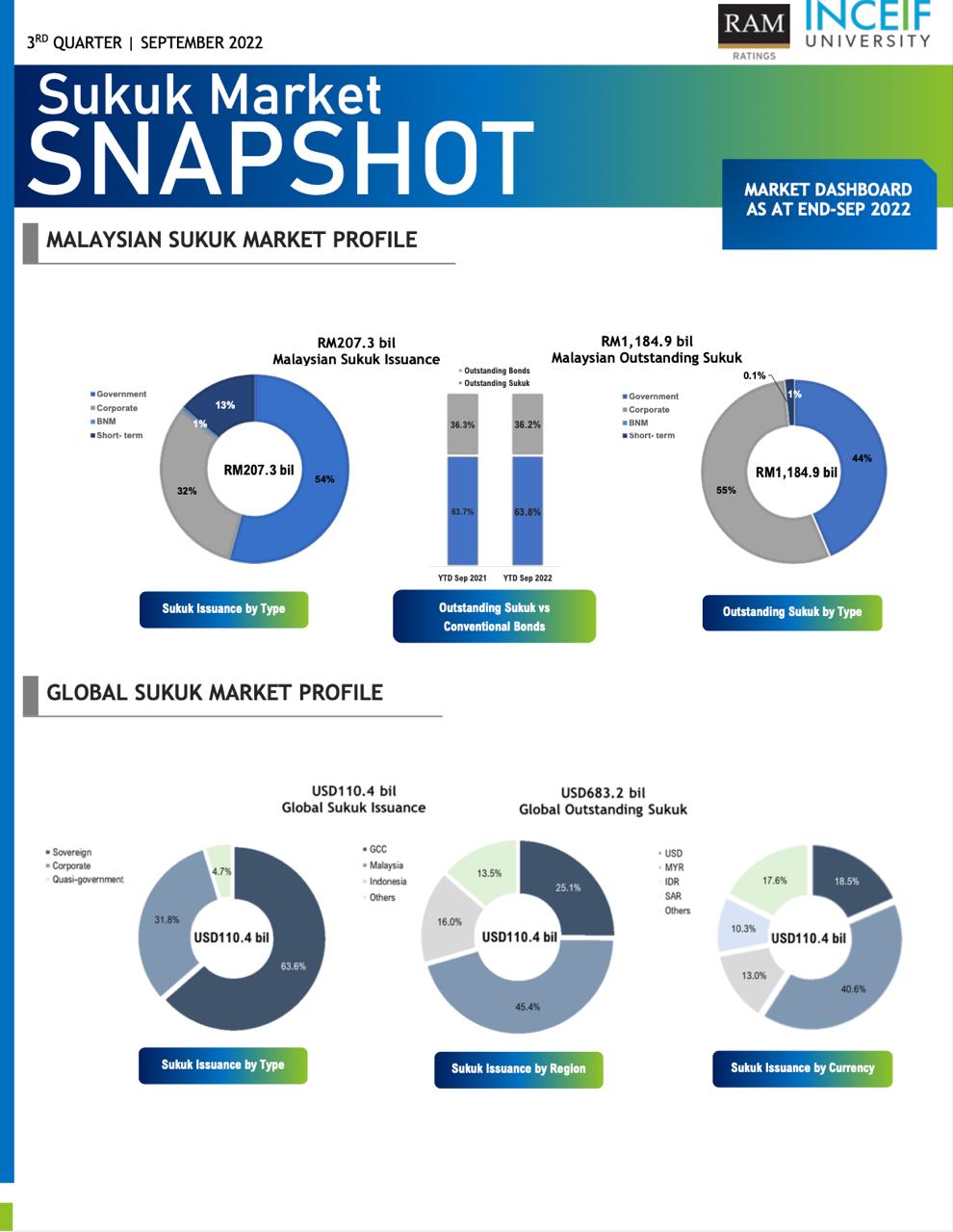
Global sukuk issuances remained subdued as at end-Sep 2022, with total issuances contracting by 13% y-o-y to USD110.43 bil amid multiple policy rate hikes and persistently high oil prices. The surge in oil prices reduced government borrowing needs for GCC issuers, evident in the 37.7% y-o-y drop in GCC sukuk issuances to USD27.75 bil as at end-Sep 2022. Corporate and quasi-government issuances also contracted by 22.5% and 30.5% y-o-y to USD35.08 bil and USD5.14 bil, respectively.
Sovereign issuances were not spared from the decline but were relatively resilient due to inflation-induced budgetary pressures on economies such as Malaysia, Indonesia, and Pakistan. As a result, sovereign issuances contributed 63.6% of global sukuk issuances as at end-Sep 2022 (end-Sep 2021: 58.6%). Global issuances are expected to moderate in the near term due to expected budget surpluses at core sukuk markets and slower economic growth.
Despite lower issuances, global outstanding sukuk increased by 4% y-o-y to USD683.2 bil as at end-Sep 2022, with the GCC region being the primary contributor accounting for 43% of the total outstanding. Outstanding sovereign sukuk contributed the majority at 58.9% as at end-Sep 2022, supported by 1H 2022 issuances from Turkey, Kuwait, Bahrain, and Pakistan that helped preserve secondary market momentum.
The sustainability drive in Islamic financial markets picked up steam with more ESG-linked government initiatives in Q3 2022. The Securities Commission Malaysia issued the Sustainable and Responsible (SRI)-Linked Sukuk Framework on 30 June 2022 to facilitate more corporates to issue SRI-linked sukuk. A key notable issuance in the quarter was Al-Rajhi Bank’s three-year USD1 bil dual tranche sustainability commodity Murabaha facility, marking the bank as the world’s first Islamic financial institution to provide Shariah-compliant sustainable financing. ESG-linked sukuk is likely to grow further based on these initiatives along with rising investor demand and awareness.