>
>
Vol. 11
No. 2 >
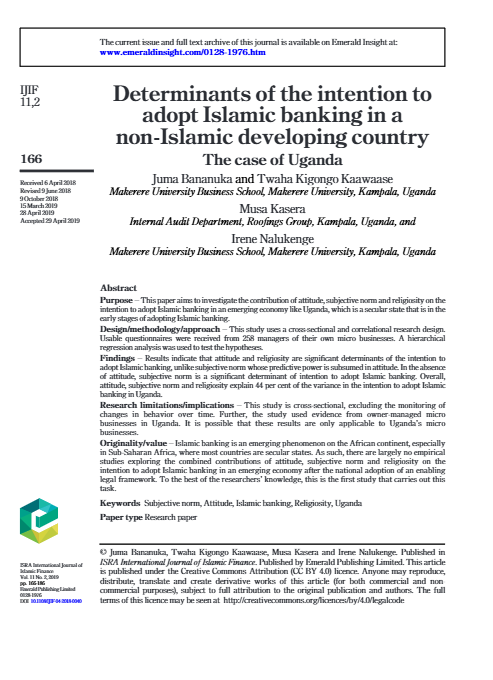
Determinants of the intention to adopt Islamic banking in a non-Islamic developing country The case of Uganda
Purpose – This paper aims to investigate the contribution of attitude, subjective norm and religiosity on the intention to adopt Islamic banking in an emerging economy like Uganda, which is a secular state that is in the early stages of adopting Islamic banking.
Design/methodology/approach – This study uses a cross-sectional and correlational research design. Usable questionnaires were received from 258 managers of their own micro businesses. A hierarchical regression analysis was used to test the hypotheses.
Findings – Results indicate that attitude and religiosity are significant determinants of the intention to adopt Islamic banking, unlike subjective norm whose predictive power is subsumed in attitude. In the absence of attitude, subjective norm is a significant determinant of intention to adopt Islamic banking. Overall, attitude, subjective norm and religiosity explain 44 per cent of the variance in the intention to adopt Islamic banking in Uganda.
Research limitations/implications – This study is cross-sectional, excluding the monitoring of changes in behavior over time. Further, the study used evidence from owner-managed microbusinesses in Uganda. It is possible that these results are only applicable to Uganda’s microbusinesses.
Originality/value – Islamic banking is an emerging phenomenon on the African continent, especially in Sub-Saharan Africa, where most countries are secular states. As such, there are largely no empirical studies exploring the combined contributions of attitude, subjective norm and religiosity on the intention to adopt Islamic banking in an emerging economy after the national adoption of an enabling legal framework. To the best of the researchers’ knowledge, this is the first study that carries out this task.